
According to Spotify, hip-hop is the third most-streamed music genre on its platform in 2023.
Let’s take a look at how this musical genre came to be. But let’s also explore how brands—and one in particular—have managed to add value to their marketing by associating themselves with this musical genre. After all, music is indeed a vital means of connection, especially among younger generations throughout the ages.
The Birth of a New Musical Genre
The birth of the musical genre is said to date back to the night of August 11, 1973, in the Bronx, New York, USA. Cindy Campbell, a teenager of Jamaican descent, organized a neighborhood party. At the time, the Bronx was extremely poor and ruled by gangs. Together with her 16-year-old brother, they came up with the idea of throwing a block party in the spirit of Kingston’s dance parties. It was he—DJ Kool Herc—who would give birth to the hip-hop genre. At the time, disco was all the rage in New York. Kool Herc had the idea of isolating the instrumental tracks—the “breaks”—from funk and soul records (James Brown, Jimmy Castor Bunch, The Incredible Bongo Band, Cymande, etc.). Coke La Rock grabbed the mic and started calling out to his friends in the crowd. The hip-hop genre was born, but it didn’t have a name yet.
In the early years, the genre didn’t make it beyond block parties because these artists refused to make commercial music. It wasn’t until 1979 that the fading singer Sylvia Robinson decided to produce a track. She put together a group called The Sugarhill Gang and released “Rapper’s Delight” (featuring a sample from Chic’s “Good Times”), which reached No. 36 on the Billboard Hot 100. It was a huge hit. The lyrics are all about partying, having fun, and the festive spirit of funk and disco.
It wasn’t until 1982 and the song “The Message” by Grandmaster Flash & The Furious Five that the first hip-hop hit emerged from the Bronx with an explicit reference to the hip-hop genre. The message became more personal, addressing the struggles of these young people in a tough neighborhood.
That same year , Afrika Bambaataa’s “Planet Rock” reached No. 48 on the Billboard Hot 100. Lance Taylor was the first DJ to perfect the mixing technique that forms the foundation of the genre. Hip-hop was truly launched on the airwaves.
How Brands Are Seizing the Opportunity
From the very beginning, low-end food brands and cheap liquors were among the first to use hip-hop to sell their products in Black neighborhoods in major American cities. The 1990s marked a turning point in the use of hip-hop in advertising. The Coca-Cola Company was one of the first brands to build Sprite’s identity through hip-hop.
In the 1980s, Sprite was lagging behind its competitor 7 Up when its parent company, Coca-Cola, decided to focus on the youth market. By the late 1980s, hip-hop’s influence on popular culture was taking shape, but it was often misunderstood. In 1986, the soda brand partnered with Kurtis Blow in a commercial where the rapper pretends to be a news anchor announcing that Sprite is better than 7 Up. It’s worth noting that Kurtis Blow was the first hip-hop artist to sign with a major label (Mercury) and the first rapper to earn a gold record with *The Breaks* in 1980.
This commercial perfectly captures the spirit of early hip-hop music: a cheerful, fun tone, powerful drum and bass lines, and a rap flow inspired by New York radio DJs (Gary Byrd, Ken “Spider” Webb, Franckie Crocker).
At first, it was simple: pairing a drink with a bold, youthful movement. But as the idea gained momentum and evolved, it grew stronger, rooted in one thing: urban authenticity.
The Marketing Director for the Bobby Oliver brand explains that he wants to give the new hip-hop scene the opportunity to promote Sprite in their own words. According to him, paying tribute to this musical genre is a mark of credibility. It’s a long-term win-win partnership that secures the brand a special place in the hearts of its target audience.
With its universality and repetitive nature, the barrage of advertising allowed hip-hop to find its way into WASP households. Until then, they had been kept on the sidelines of the musical revolution unfolding in the United States during the 1990s. Hip-hop became mainstream, and advertising strategies played a part in that. Urban music managed to carve out a place for itself in the pop culture of the era, thanks in large part to cult-classic albums and innovative artists such as Run DMC’s *My Adidas* in 1986.
Sprite and Hip-Hop: A Long-Term Partnership
Sprite's creative team recognized the stories being told and the resilience of the artists behind them, and sought out collaborations.
Bobby Oliver: “Music is important and plays a role in our lives”
Bobby Oliver: “Sprite has been doing this since the 1980s, and in hip-hop, there was a creative power in this new form that really resonated with people. We embraced that and rooted ourselves in that culture.”
Heavy D (1990), Kid’N’Play (1991), A Tribe Called Quest (1994), Pete Rock, CL Smooth, and Grand Puba (1995), KRS-One & MC Shan (1996), Nas & AZ ( 1997), and Missy Elliott and Common in 1998—Sprite is banking heavily on these collaborations.
By the late 1990s, Sprite had spent about $70 million on the “Obey Your Thirst” campaign, tripled its sales, and secured a majority market share in the citrus beverage category. Over the years, Sprite has continued to be one of the most consistent brands in hip-hop.
In 2015, the brand reaffirmed its strong connection to rap. For one thing, through the documentary web series Obey Your Thirst , co-produced with The Fader magazine, which features Nas, Drake, Vince Staples, and Isaiah Rashad. What Sprite did differently was that it didn’t go after the most famous artists or celebrities; instead, they sought out artists who appreciated the culture, and the ads had an authentic tone.
Hip-hop continued to evolve over the next 30 years. It is now an integral part of today’s music scene. The early pioneers inspired a new generation of artists, and Sprite responded by demonstrating its ongoing understanding and respect.
The “ Summer Sprite Cold Lyrics Series " is the third installment. Bobby Oliver: “We felt that the words we chose from their lyrics perfectly capture the cool, refreshing, delicious, and essential qualities of Sprite that we want to promote.”
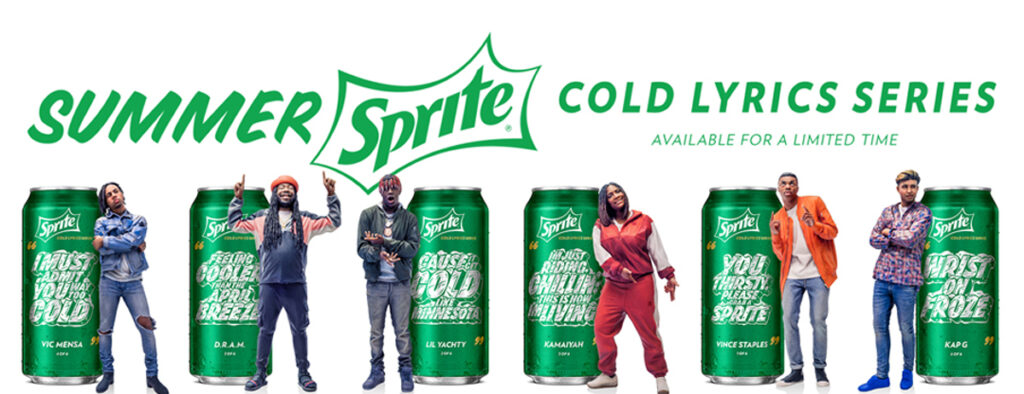
Bobby Oliver: “It’s about staying true to what hip-hop was supposed to be, what it originally meant to our fans, and simply providing them with a platform where they can enjoy it.”
Urban Authenticity
Sprite has successfully cultivated urban authenticity and built on it in a way no other brand has been able to. In 1991, Public Enemy released *Apocalypse ’91: The Empire Strikes Back*. The album features “100 Bottle Bags,” a direct critique of malt liquor companies that specifically target urban communities through hip-hop.
The Sprite brand has successfully capitalized on the artistic movement without limiting itself to the genre, as this compilation of Sprite commercials shows. What the brand wanted to do was acknowledge the popularity of hip-hop and the fact that artists in this genre are truly seeking to express themselves. For nearly 40 years, Sprite has sought to stay true to who these artists are. They have a voice and a point of view. Sprite simply felt, “Hey, we can help give you a platform from which you can express that.”
It’s a mutually beneficial partnership because the brand simply wants to help artists rise up so they can express themselves. The challenge is staying true to who they are and what they believe in, because the brand is convinced that we all have a voice and everyone deserves to be heard.
If you're interested in hip-hop and brands, you might find this article on slam poetry for brands interesting.
Sources:
- The Forgotten Story of “The Mother of Hip-Hop,” Cindy Campbell
- How Hip-Hop Made Its Mark in Advertising
- Lil Yachty, Vince Staples, DRAM, and Others Team Up with Sprite for Summer Lyrics Campaign
- The Coca-Cola Company - Sprite and Hip-Hop – A partnership rooted in urban authenticity
- Music Sermon: The Groundbreaking Sprite and St. Ides Hip-Hop Campaigns